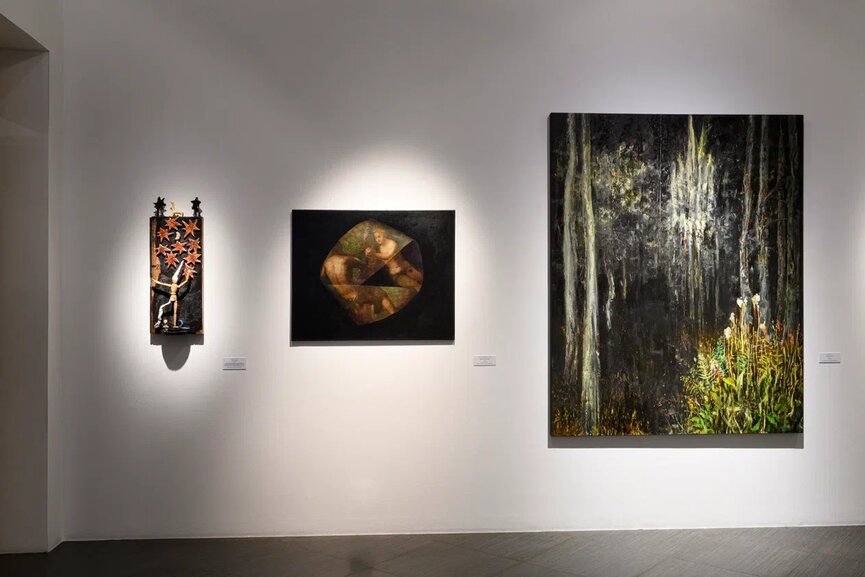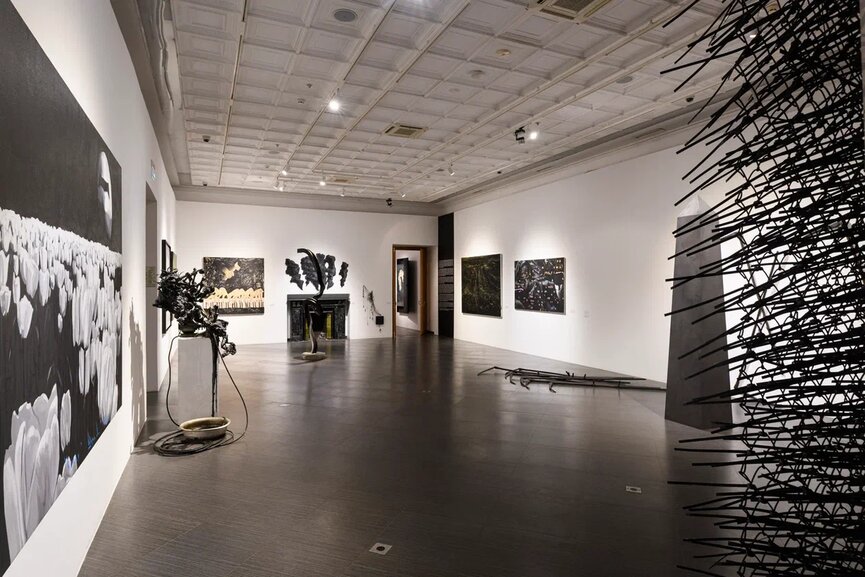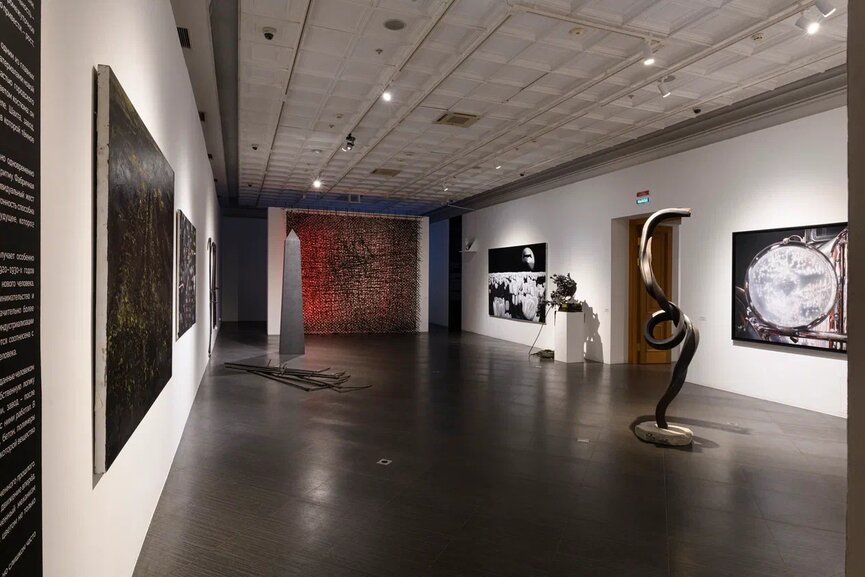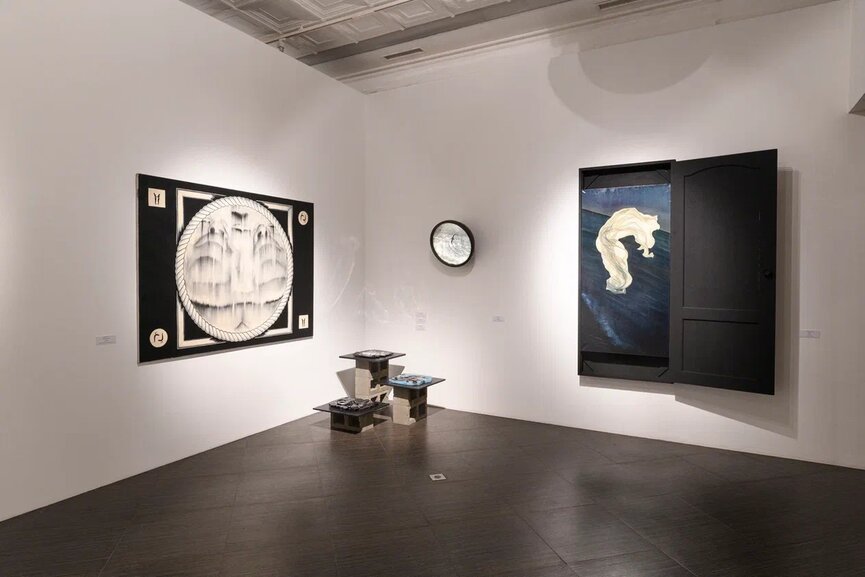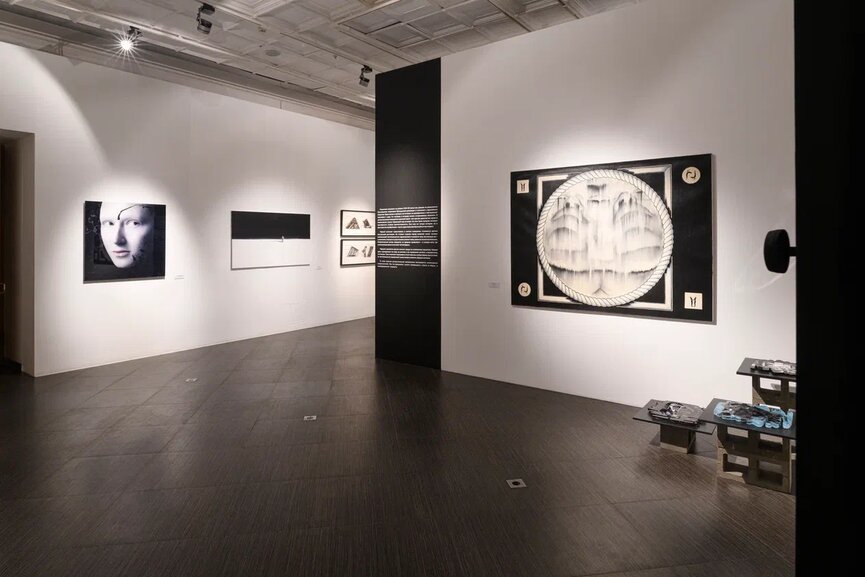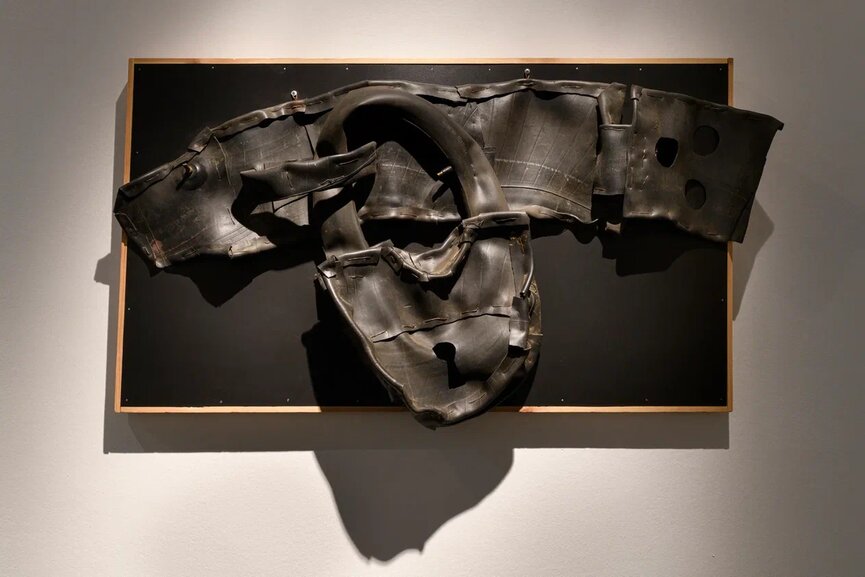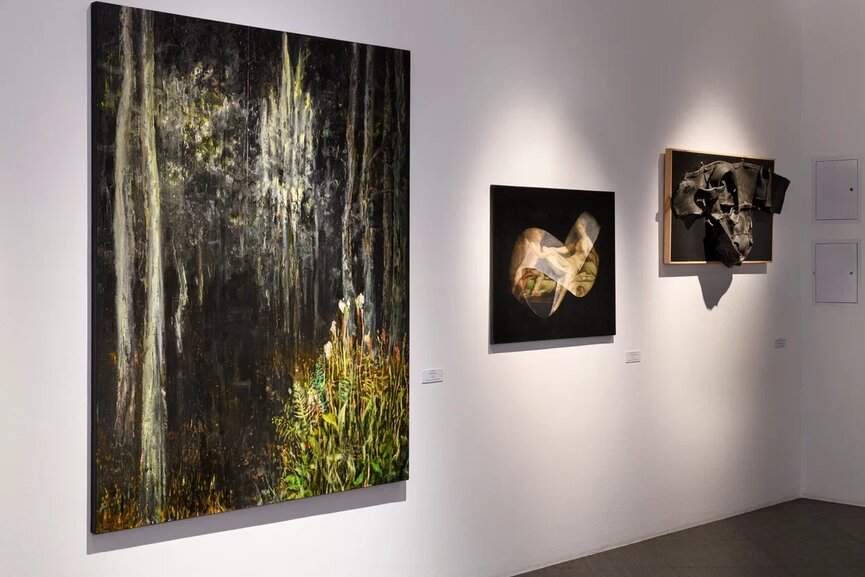
The history of the color black is the history of humanity’s transformations: its fears, the established mechanisms of power, spiritual quests, and aesthetic revolutions that continue to this day. The “History of the Color Black” project at the EKATERINA Cultural Foundation, curated by Dmitry Gaikov and Alena Dyatko, brings together more than 80 contemporary artists who, in eight halls of the exhibition space, explore the multivalence of black in its social, psychological, and symbolic aspects.
The exhibition features works by such artists as Pyotr Shvetsov, Vladimir Kustov, Dmitry Gretsky, Vladimir Kozin, and the duo of Gubanova and Govorkov.
Each work is an independent and at the same time important element of the cohesive exhibition. On the one hand, the viewer can observe the individual artist’s perspective on the nature of black (about half of the works were created specifically for the project); on the other hand, it is a discussion of the symbolic anthropology of black in each of the halls.
The first hall explores the theme of the birth of the world from the chaos of black. For a long time, black was excluded from the range of colors, and yet, without yet being a color, it became established as the starting point of human existence. The second hall is devoted to archaic themes, the first pigments, and the study of the possibilities of black. In the third hall, black is examined as the color of fertility and life. The fourth and fifth halls explore black in the Middle Ages, where, on the one hand, it is the color of Christian darkness, and on the other hand, it is an integral part of mystical rituals. The sixth hall is dedicated to the “very dark ages” (M. Pastoureau). In the history of science, the 17th–18th centuries are the era of the Enlightenment and Reason, yet both in religious and social terms, as well as in terms of morality and symbolism, these are dark ages: coarseness of manners, intolerance, hardships, and rigidity of opinion — this is not the “Middle Ages,” but the age of Louis XIV and Versailles. The seventh hall is dedicated to the “smoke of the industrial revolution”; further, in the eighth hall, black appears in a post‑digital consciousness; it is psychologized in a strange way, acquiring additional meanings — from “screen shutdown” to the painful nostalgia for the past.
One of the project’s important tasks is to return to dialogue. A discussion about black in the language of art makes it possible to build a symbolic polyphonic dialogue in which recognized masters (Eric Bulatov, Eduard Steinberg, Olga Tobreluts, Andrey Filippov, Vladimir Nemukhin, Kirill Chelushkin) join forces with new heroes (Kirill Manchunsky, Alexandra Granovskaya, Alexey Bevza, Katya Nikitina, Elena Filaretova).
Inspired by the works of the historian of colour Michel Pastoureau, the curators propose an interdisciplinary approach not only to the exhibition but also to the parallel programme prepared within the framework of the exhibition. In addition to curatorial tours, meetings with artists, philosophers, sociologists and theologians are planned. The invited experts will complement the space of the halls with their texts, which will enhance the study of black as part of the cultural code, the elements of which change meaning depending on the era, religion, ideology and worldview. The text is taken from the website of the Ekaterina Cultural Foundation.