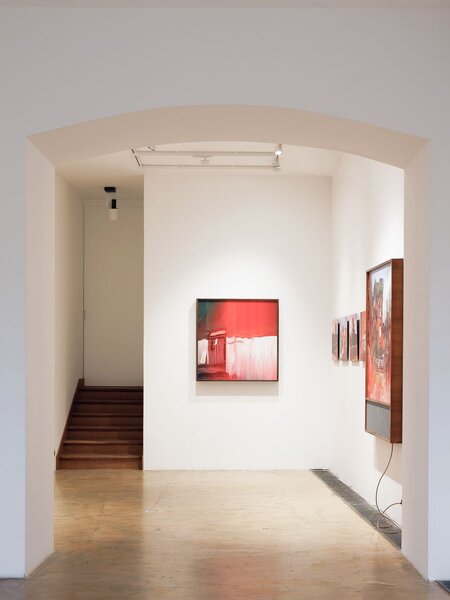
Sergey Poteriaev builds his series at the intersection of documentary photography, installation and sound practices. His method is an anthropological examination of a territory where the past continues to pulsate in the present, like an old noise in the wall. In the new chapter of the project "Soundscape. New Symphonies" the artist refers to the former industrial facilities of St. Petersburg — the "red" factories of the historical center, turned into offices, public spaces and art clusters. He reads them as complex cultural scores, where the memory of the place, the history of production, and modern urban life are intertwined into a single field of expression. The photograph here does not so much document as it does notate; the sound, reprocessed with the participation of composer Anton Shanikhin, becomes an independent character. In addition to photographs, the exhibition will include audiovisual objects: the sound for them was recorded directly at industrial sites. One of the key gestures is an homage to Arseny Avraamov’s “Symphony of Horns” — a utopian score of factory sirens, which today sounds more like a ghostly accompaniment to the developer boom than a hymn to the collective body. The project continues Potaev’s research line, which is related to studying the variability of visual language and searching for personal history in the context of fading eras.
Sergey Potaev:
In “Sound Landscape. In “New Symphonies,” I pay homage to Avramov’s works and experiments. On the one hand, just as in the master’s work, I combined different parts of the city: the outskirts and the city centre, the industrial and tourist areas; on the other hand, I established a connection with different historical periods through a partial re‑enactment of an event. Taking into account the context in which “Sound Landscape. New Symphonies” emerged, I decided to change the principle behind the creation of the work. In 2026, as the industrial era comes to an end with the development of new technologies and most factories have left the territories of large cities, the sound of the musical composition in the project also moves from the street to the gallery — effectively from the physical space to the space of the imaginary, mirroring the widespread trend of this transition. Instead of live performance, in my works I use field recordings of streets, which will be played simultaneously at the exhibition, combining to form a temporary musical composition. Using a special program, landscape photographs were altered with the help of the recorded sound, following the principle of creating a spectrogram — images showing the dependence of signal power density on time. The result was a series of works in which the images were enhanced and distorted by sound, creating a new landscape.
Curator: Oksana Ilzina